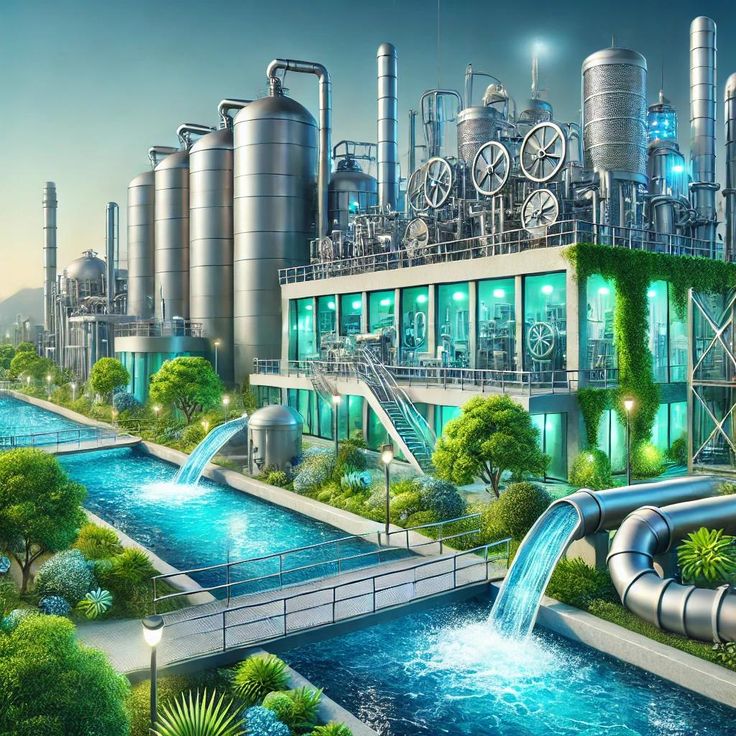
Water Treatment and Desalination Plant Development: From Water Source Engineering to a Sustainable Water Production System

Introduction: When Water Becomes an Engineering Project, Not Just a Natural Resource
In today’s world, the water challenge is no longer just a matter of how much rainfall a country receives or how many rivers and lakes it has, as was once the case. The far more complex question today is: how do we turn any available water source — regardless of its nature, salinity, or level of contamination — into safe, reliable water that can be depended on continuously, whether for human or industrial use?
This is precisely where water treatment and desalination engineering emerged as one of the fields most closely tied to food, health, industrial, and urban security.
A water treatment plant is not simply a collection of tanks, pumps, and filters, and a desalination plant is not simply a set of membrane units that remove salts. A truly successful plant is an integrated system that begins before the water even reaches the first treatment unit, continues through the delivery of finished water into the distribution network, and extends further still to the management of waste and reject streams and the monitoring of performance — both chemical and biological — over years of operation.
A common mistake is to view the construction of a water plant as simply a matter of purchasing, installing, and operating equipment. The engineering reality is far more complex: even excellent equipment can deliver poor results if it is selected based on specifications that do not match the raw water, and even the best treatment technologies can fail if they are not built on a rigorous study of the water source, or if operation and maintenance are neglected.
This is why the real question is not “what is the best water treatment technology?” but rather, more precisely: “what is the best treatment system for this particular water source, for this particular use, at this required quality, within this budget, with the lowest possible operational and environmental risk, and with the highest possible productivity and efficiency?”
This shift in thinking is the difference between a plant that simply works, and a plant that operates efficiently, reliably, and economically for many years.
Understanding the Water Before Designing the Treatment Plant
The first rule of water engineering is that it is the raw water that dictates the plant’s design — not the other way around.
Groundwater differs from river water, well water differs from seawater, surface water differs from treated wastewater, and even within a single source category there can be major differences from one location to another.
This is why professional projects typically begin with a comprehensive characterization of the water source. Chemical, physical, and microbiological analysis covers a wide range of parameters, most importantly:
- Temperature
- pH
- Turbidity
- Total Dissolved Solids (TDS)
- Electrical conductivity
- Total hardness
- Calcium and magnesium
- Sodium and potassium
- Chlorides and sulfates
- Bicarbonates
- Iron and manganese
- Silica
- Nitrates
- Ammonia
- Sulfides, where present
- Organic matter
- Oils and grease in some sources
- Microbial contaminants
- Any site-specific contaminants linked to the location or surrounding industrial activity
A single analysis is never enough to design an entire plant around, since many water characteristics change seasonally, and some change with the rate of withdrawal, tidal cycles in marine sources, temperature, or shifts in surrounding industrial and agricultural activity.
A thorough study, therefore, does not only ask “what is the water quality today?” — it also asks how water quality might change tomorrow, and five years from now. This question is critical when designing plants meant to operate reliably over a long service life.
The Fundamental Difference Between Water Treatment and Desalination
The terms “water treatment” and “desalination” are sometimes used interchangeably, yet clear engineering distinctions exist between them.
Water treatment refers to the set of processes aimed at removing or reducing contaminants and improving water characteristics so that it becomes suitable for its intended use.
Desalination, on the other hand, is a process focused primarily on removing dissolved salts from saline or highly saline water, together with the necessary pre- and post-treatment stages required to protect the system and ensure product quality.
If raw water contains turbidity, organic matter, and microbes, it may require coagulation, flocculation, sedimentation, filtration, and disinfection. But if seawater is the source, the greater challenge is not merely removing turbidity or organic matter — it is managing a very high concentration of salts and other substances that affect membranes and equipment.
In this sense, desalination is not a substitute for primary treatment; it is part of a more complex overall treatment system.
Stages of Conventional Water Treatment
Treatment stages vary depending on the type of raw water, but conventional drinking water plants typically include a series of successive units.
Intake and Lift Station
The plant begins at the intake point, where the water withdrawal system must be designed to provide a stable flow while limiting the entry of large solids, debris, algae, and sediment as much as possible. The intake may include:
- Mechanical screens
- Bar screens
- Rotating drum screens
- Lift pumps
- Sediment removal systems
- Protective measures against aquatic organisms, depending on the nature of the source
The intake may appear to be a minor component in some projects, but in reality it can be one of the most influential factors in overall plant reliability. A poorly designed intake will pass its problems on to the rest of the plant, no matter how good the downstream equipment is.
Coagulation
Many surface waters contain fine particles that cannot be easily settled due to their small size and electrical charge. Coagulant chemicals are used here to destabilize these particles.
Dosing should never be arbitrary — it must be carefully determined to achieve the best performance. Tests such as the Jar Test are used to establish the appropriate dose, taking into account temperature variation and water characteristics.
The goal is not to add the largest possible amount of coagulant, but to achieve the best performance with the lowest possible chemical consumption.
Flocculation and Sedimentation
After coagulation comes flocculation, where small particles combine into larger clusters that are easier to separate. The water then moves on to sedimentation units, which may take the form of:
- Conventional sedimentation basins
- Horizontal clarifiers
- Vertical clarifiers
- Inclined-plate (lamella) clarifiers
- Or more advanced technologies depending on the nature of the project
A sedimentation basin should never be viewed as merely a large tank — it is a hydraulic separation unit with specific loading rates, retention times, flow distribution, and precise design constraints. Poor flow distribution within the basin can reduce sedimentation efficiency even if the basin’s size appears adequate on paper.
Filtration
After sedimentation, water usually needs a filtration stage to remove remaining particles. Multiple technologies are used for this purpose, including:
- Sand filters
- Multi-media filters
- Rapid filters
- Cartridge filters
- Microfiltration membranes
- Ultrafiltration membranes
The appropriate technology depends on the required water quality. A common mistake is selecting a filter type based solely on flow rate, without considering solids characteristics, clogging rate, backwash cycles, and inlet/outlet water quality.
Disinfection and Microbiological Safety Assurance
Even after removing turbidity and suspended matter, water cannot be assumed to be microbiologically safe. This is why disinfection is an essential stage in drinking water plants. Among the most well-known disinfection technologies are:
- Chlorine
- Chlorine dioxide, in certain applications
- Ultraviolet (UV) radiation
- Ozone
Each technology has its own advantages and limitations. Chlorine, for example, is valued for providing a residual effect within the distribution network, while UV depends on delivering the appropriate radiation dose to the water and typically does not provide a lasting disinfecting effect within the distribution network. For this reason, some systems use more than one technology under the concept of multiple barriers.
This is one of the most important modern principles in drinking water engineering: water safety should never depend on a single point within the plant. Instead, there should be successive layers of protection, so that a limited failure at one stage does not directly compromise the safety of the final product.
When Do We Need a Desalination Plant?
Desalination becomes a logical option when the water source is highly saline, or when the available conventional water is insufficient to meet demand. Among the most common sources subjected to desalination:
- Seawater
- Brackish groundwater
- High-salinity well water
- Certain types of industrial water
Several desalination technologies exist, but Reverse Osmosis (RO) has become one of the most widely used technologies worldwide, particularly in projects that require water with very low salinity — sometimes approaching zero — as in medical applications and certain industries.
How Does Reverse Osmosis Technology Work?
Reverse osmosis relies on semi-permeable membranes that allow water to pass through more readily than most dissolved salts and solids. In natural osmosis, water moves according to concentration differences and osmotic pressure; in reverse osmosis, pressure is applied to the saline water that exceeds the osmotic pressure, forcing water through the membranes while a large proportion of the salts is rejected.
The process typically produces two main streams:
- Permeate: the water that has passed through the membranes and become lower in salinity.
- Concentrate: the water that retains a higher proportion of salts and rejected substances.
An important issue emerges here: salts do not disappear during the desalination process — they are simply separated from the product water and transferred to another, more concentrated stream, commonly known as brine or concentrate.
Pretreatment Is the Heart of a Desalination Plant
Some may assume that the most important part of a reverse osmosis plant is the membranes, but operational experience shows that membrane success depends heavily on what happens before them. Membranes are sensitive to fouling, scaling, organic matter, fine particles, and certain types of microbial activity. This is why an appropriate pretreatment system must be designed, which may include:
- Screens
- Solids removal
- Coagulation and flocculation
- Sedimentation
- Multi-media filtration
- Ultrafiltration (UF)
- Cartridge filters
- pH adjustment
- Antiscalant dosing
- Chemical treatment depending on water type
There is no single recipe that suits every desalination plant; pretreatment for an open seawater intake can differ radically from treatment for a brackish well.
Why Do Desalination Membranes Fail?
There are two well-known phenomena known as fouling and scaling. Fouling relates to the accumulation of various substances on the membrane surface, which may include organic or biological matter or particulates, while scaling relates to the deposition of low-solubility salts on the membranes. Among the most common scale-forming compounds:
- Calcium carbonate
- Calcium sulfate
- Certain barium and strontium salts
- Silica under certain conditions
These phenomena lead to reduced product water flow, an increased pressure differential, and a greater need for chemical cleaning. This is why designing a desalination plant does not end simply by calculating the number of membrane vessels required — it must also include a precise chemical understanding of scaling and fouling potential.
Membrane Selection Is Not Just a Commercial Decision
The market offers a large number of reverse osmosis membranes, but membrane selection should never be based solely on price or the advertised production rate. Consideration should be given to:
- Water salinity
- Water temperature
- Operating pressure
- Recovery rate
- Required water quality
- Fouling potential of the source
- Expected replacement rate
- Cleaning cost
- Spare parts availability
- Operating team experience
Green Life is committed to supplying the best and most efficient components within this framework.
The cheapest membrane to purchase can turn out to be the most expensive over the plant’s life cycle if it requires frequent cleaning or degrades quickly. This is why it is essential to choose the units with the highest operating efficiency and a proven record of excellent performance.
This is where an important concept in modern engineering projects emerges: Life Cycle Cost, rather than merely the initial purchase cost.
Recovery in Desalination Plants
One of the most important design indicators in reverse osmosis plants is the recovery rate, which simply expresses the proportion of raw water converted into product water. Increasing the recovery rate may seem economical, since it increases the amount of usable water and reduces the volume of concentrate, but pushing it too high can raise salt concentration within the system, increase scaling risk, and affect the membranes.
Reaching an appropriate recovery rate is therefore a balancing act between:
- Quantity of product water
- Energy consumption
- Chemical consumption
- Scaling risk
- Volume of concentrate
- Membrane lifespan
This equation is what distinguishes genuine engineering design from design based solely on maximizing a single number.
Energy in Desalination Plants
One of the greatest challenges in desalination is energy consumption, since the pressure required to push water through reverse osmosis membranes represents a significant share of the plant’s total energy use. This is why energy recovery systems have become one of the most important developments in seawater desalination plants.
Energy recovery systems capture the pressure energy present in the concentrate stream instead of losing it entirely, which can reduce energy consumption and improve operating economics. Once again, however, an energy recovery system should not be chosen as a standalone component — it must be evaluated as part of the plant’s complete hydraulic design.
Post-Treatment Is No Less Important Than Desalination Itself
Water leaving a reverse osmosis plant can be so low in salinity that it becomes chemically unbalanced for direct use in certain applications. Product water therefore usually requires post-treatment, which may include:
- Remineralization
- pH adjustment
- Alkalinity addition
- Hardness adjustment
- Final disinfection
The goal is not simply to reach the lowest possible salt figure — and this is a crucial point: the ideal water, from an engineering standpoint, is not necessarily the water with the lowest TDS, but the water that achieves the quality appropriate for its final use, together with the required chemical and microbiological stability.
Product Water Tank Design
Focus is sometimes placed on treatment units while water storage tanks are neglected, yet the tank is an important part of the plant system and, in fact, a major factor in product water quality. The following should be studied:
- Tank size
- Inflow and outflow rate
- Retention time
- Stagnation potential
- Ventilation
- Contamination protection
- Ease of cleaning
- Level measurement systems
- Alarm systems
- The relationship between the tank and the distribution network
A poorly designed tank can turn water that was of excellent quality when it left the plant into lower-quality water after hours or days of storage.
Brine Management: The Issue That Cannot Be Deferred
One of the most sensitive issues in desalination plants is the disposal of concentrate water, since brine contains a higher concentration of salts and certain chemicals used during the treatment process.
In coastal projects, marine discharge may be a viable option once the necessary environmental and hydraulic studies have been carried out, but not every coastal site is suitable in the same way. The following must be studied:
- The nature of marine currents
- Discharge depth
- Water temperature
- Ecosystem sensitivity
- Dilution and dispersion rates
- Intake location relative to discharge location
- The impact of residual chemicals
In inland areas, more complex challenges may arise, and management options may include:
- Evaporation ponds, under suitable conditions
- Discharge to licensed systems
- Recovery-enhancement technologies
- Crystallization
- Certain advanced concentration technologies
- Partial reuse in suitable applications
For this reason, the brine issue must be addressed at the very first stage of project design — not after the design has been completed. This is one of the advantages of working with Green Life to properly complete a project.
Building a Successful Desalination Plant Starts With a Genuine Feasibility Study
Before finalizing a plant’s design, a comprehensive feasibility study must be carried out, typically including:
Water Availability Study
- How much water is available?
- Is the source stable?
- Are there seasonal variations?
- Can the source sustain the required withdrawal rate?
Chemical Study
- What are the water’s characteristics?
- What are the main contaminants?
- What is the scaling potential?
- What type of pretreatment is required?
Engineering Study
- What capacity is required?
- What is the flow rate?
- What pressure is required?
- What is the site area?
- What are the energy requirements?
Economic Study
- What is the construction cost?
- What is the energy cost?
- What is the chemical cost?
- What is the membrane replacement cost?
- What is the labor and maintenance cost?
Environmental Study
- How will the brine be disposed of?
- What is the project’s impact on the source?
- Are there special environmental requirements?
Site Selection
The ideal plant site is not necessarily the closest point to the sea or a well; a range of considerations must be weighed together, including:
- Proximity to the water source
- Proximity to the point of water consumption
- Electricity availability
- Ease of access
- Land characteristics
- Site elevations
- Flood risk
- Space for future expansion
- Water transmission lines
- Concentrate discharge lines
- Environmental requirements
- Security and safety
In large-scale projects, site selection can become a factor that influences project cost for decades to come.
Electricity and Power Systems
A desalination plant is as much an electrical facility as it is a water facility, since pumps, control systems, valves, and auxiliary equipment all depend on a stable power system. The power system must therefore be designed based on:
- Peak load
- Critical loads
- Motor starting currents
- Power factor
- Frequency and control systems
- Emergency generators
- Uninterruptible power supply systems for sensitive equipment
- Future expansions
One of the most serious mistakes is designing the power source based solely on average consumption, since engineering systems are not called upon to perform at average conditions when peak operating conditions occur.
Automation and Control Are Not a Luxury
A modern plant needs a control and monitoring system capable of tracking performance moment by moment. Measurements may include:
- Pressure
- Flow
- Conductivity
- TDS
- pH
- Turbidity
- Temperature
- Tank levels
- Pressure differential across filters
- Product water quality
Modern SCADA systems allow the plant to be monitored, data to be analyzed, and alarms and events to be logged. But the value of a control system does not lie in the number of screens — the real value lies in turning data into operational decisions. For example, a rising pressure differential across a filtration stage may be an early sign of clogging that requires intervention before it becomes a bigger problem.
Maintenance Begins at the Design Stage
A plant that is difficult to maintain is a costly plant, no matter how excellent it may be at initial commissioning. This is why maintenance must be considered from the design stage onward. Key considerations include:
- Ease of access to pumps
- Ability to lift and replace heavy equipment
- Adequate space around equipment
- Availability of critical spare parts
- Presence of bypass lines when needed
- Design suited to cleaning operations
- Ease of isolating each unit
- Availability of backup instrumentation at critical points
A clear list of critical equipment should also be prepared, such as:
- High-pressure pumps
- Feed pumps
- Energy recovery systems
- Membranes
- Chemical dosing pumps
- Measuring instruments
- Critical valves
Chemical Cleaning of Membranes
Even with good pretreatment, membranes will eventually require cleaning — a process known as CIP (Cleaning in Place). The cleaning program is chosen according to the nature of the fouling or scaling; organic fouling is not necessarily similar to inorganic scaling, so using a single cleaning agent for every case can be ineffective, or even harmful.
The decision to clean should be based on operational indicators such as:
- A drop in temperature-corrected flow
- An increase in pressure differential
- A change in product water quality
- A change in performance relative to baseline
It is important to maintain accurate membrane performance records from day one.
Performance Indicators That Reveal the Health of a Plant
A plant should never be evaluated based solely on the question “is it producing water?” — a set of performance indicators must be tracked, most importantly:
- Daily production: the quantity of water produced.
- Product quality: conductivity, TDS, and other required indicators.
- Recovery rate: the ratio of product water to feed water.
- Energy consumption: the amount of energy needed to produce a unit of water.
- Chemical consumption: an important indicator of cost and performance.
- Membrane run time: before cleaning or replacement is needed.
- Number of breakdowns: an indicator of reliability.
- Downtime: and its impact on production.
Most important of all is monitoring trends rather than isolated figures, since a gradual decline in performance can be more significant than a sudden drop, as it allows for intervention before reaching a stage of failure.
Mistakes That Cost Water Plants Millions of Dollars
There are recurring mistakes in water treatment and desalination projects.
Mistake One: Purchasing a Ready-Made Plant Before Analyzing the Water
This is one of the most dangerous practices: purchasing a desalination unit with a fixed capacity and generic specifications, then attempting to operate it on a source entirely different from the one it was designed for. In our projects, by contrast, we first determine the properties required for the design, and only then begin selecting the components appropriate to the project — this is one of the main reasons behind the success of our projects.
The result can be:
- Reduced production
- Increased energy consumption
- Recurring membrane clogging
- Higher maintenance costs
- Shortened service life
Mistake Two: Focusing on the Initial Price
A company’s offer may be cheaper than its competitors’, but once the following are accounted for:
- Energy
- Membranes
- Chemicals
- Spare parts
- Labor
- Maintenance
- Downtime
the cheaper offer can turn out to be the most expensive over the years of operation.
Mistake Three: Ignoring Variability in Raw Water Quality
Designing a plant based on a single analysis alone can lead to problems down the line.
Mistake Four: Neglecting the Brine
A desalination plant should never be built with the intention of figuring out concentrate disposal later.
Mistake Five: Designing a Plant Without Room for Expansion
Needs can double within just a few years, and if the site does not allow for expansion, increasing production becomes far more complex and costly.
A Good Plant Is Not the Biggest — It’s the Best Fit
It is easy to assume that the largest or most complex plant is the best, but engineering does not work that way. A small, precisely designed plant can be more economical and operationally superior to a massive plant equipped with technologies the project does not actually need, since efficiency is not measured by size, but by product water quality and the efficiency of the units used.
The goal is to strike a balance between:
- Quality
- Reliability
- Cost
- Energy
- Ease of operation
- Environmental impact
This is why designing a water plant is, at its core, an optimization process rather than an equipment-selection exercise.
Desalination and Water Reuse
The future of water management will not depend on a single source. Countries and communities facing growing water stress are moving toward diversifying their sources by combining:
- Seawater desalination
- Brackish groundwater desalination
- Reuse of treated wastewater
- Reducing losses in water networks
- Rainwater harvesting where appropriate
- Improving industrial and agricultural use efficiency
For this reason, a desalination plant should be viewed as part of an integrated water management system, not as a standalone facility.
AI and Data Analytics in Water Plants
Digital technologies are gradually entering the water sector, and historical data can be used for:
- Predicting membrane performance degradation
- Detecting abnormal patterns
- Optimizing chemical dosing
- Predicting maintenance needs
- Reducing energy consumption
- Improving washing and cleaning processes
The more data that is collected, the greater the need for someone who understands what that data means and can distinguish natural variation from changes that signal a genuine problem.
The Human Element: The Link That Cannot Be Replaced
A plant may have the latest membranes, the best pumps, and the most advanced control systems, yet it will still be at risk of failure if the operating team is not properly qualified. Engineers and technicians are a critical, essential element in plant operation. Plant operators need to understand:
- The water pathway
- The function of each unit
- Operating limits
- Chemicals
- Safety procedures
- How to respond to alarms
- Washing procedures
- Sampling
- Reading instrumentation
- Emergency procedures
There should be written Standard Operating Procedures (SOPs) for every essential process, and operational events must be logged rather than relying on memory. A plant without a documented operating history loses much of its ability to learn from its mistakes — and this is a vital part of what makes our projects efficient.
Discussing Cost More Professionally
When studying the cost of a desalination plant, cost should be broken down into major components.
Capital Expenditure (CAPEX)
Generally includes:
- Civil works
- Buildings
- Tanks
- Pumps
- Membranes
- Pretreatment units
- Electrical systems
- Control systems
- Intake and discharge lines
- Installation works
- Testing and initial commissioning
Operating Expenditure (OPEX)
Includes:
- Electricity
- Chemicals
- Membranes
- Spare parts
- Labor
- Laboratory
- Maintenance
- Waste and brine disposal
- Downtime costs
The right investment decision, therefore, does not depend on construction cost alone — it depends on the total cost of water over the entire life of the project.
How Is a Desalination Plant Built Professionally?
A professional project cycle can be summarized in a series of successive phases.
Phase One: Defining Requirements
- How much water is required?
- What is the final use?
- What is the required quality level?
- Is demand constant or variable?
Phase Two: Source Study
- Water analysis
- Seasonal testing
- Identifying potential changes
Phase Three: Technology Selection
- Is conventional treatment required?
- Membrane filtration?
- Reverse osmosis?
- A combination of technologies?
Phase Four: Preliminary Design
- Developing the general layout
- Determining capacities
- Determining water flow rates
Phase Five: Detailed Design
Includes the design of:
- Hydraulics
- Mechanical systems
- Electrical systems
- Controls
- Civil works
- Chemical systems
- Safety systems
Phase Six: Procurement and Execution
Selecting suppliers and contractors based on experience and quality, not price alone.
Phase Seven: Testing
Testing equipment individually, then testing systems, followed by fully integrated operation.
Phase Eight: Trial Operation
Confirming that the plant reaches:
- Required production
- Water quality
- Operational stability
- Energy performance indicators
Phase Nine: Handover and Operation
Handing over documentation, drawings, maintenance programs, and staff training.
A Desalination Plant as a Long-Term Investment
One of the most important concepts an investor or project owner must embrace is that a desalination plant is not a project that ends the moment it starts operating — commissioning marks the beginning of a new life cycle. The plant will need:
- Continuous monitoring
- Regular maintenance
- Operational improvements
- Instrument upgrades
- Membrane replacement
- Spare parts management
- Energy consumption review
- Staff training
It is often possible to improve the performance of an existing plant without replacing it entirely — simply by addressing bottlenecks, re-optimizing operating conditions, and upgrading certain components.
Toward the Concept of “Fit-for-Purpose Water”
One of the most important ideas for the future of the water sector is that water quality must match its intended use; the water required for drinking is not necessarily the same water required for certain industrial uses. Likewise, some industries need extremely low-conductivity water, while other applications do not require the same level of purity.
Designing a plant that produces water of far higher quality than is actually needed can mean:
- Higher capital costs
- Higher energy consumption
- Unnecessary additional treatment
- Higher operating costs
Smart engineering is what determines the precise quality required, and then builds the treatment process around it.
The Future Is Not Just About Producing Water, But Producing It Efficiently
The real challenge facing the desalination sector is not simply producing more water — the world needs water that is safe, reliable, economical, and environmentally sustainable. This is why plant development is moving toward:
- Reducing energy consumption
- Improving energy recovery
- Advancing membrane technology
- Increasing pretreatment efficiency
- Increasing recovery where conditions allow
- Reducing chemical use
- Improving brine management
- Leveraging renewable energy where appropriate
- Relying on digital monitoring
- Increasing reliability and reducing downtime
Together, these elements will define the next generation of water plants.
The Water That Reaches the Tap Began Its Journey With an Engineering Decision
When a person turns on a tap, they see what looks like a simple product, but behind it lies a long chain of decisions, studies, and tests:
- A source that must be understood
- Raw water that must be analyzed
- Contaminants that must be identified
- A technology that must be chosen
- Pumps that must be sized
- Membranes that must be protected
- Energy that must be managed
- Brine that must be disposed of responsibly
- A network that must preserve water quality after it leaves the plant
For this reason, building a successful treatment or desalination plant does not begin with an equipment catalog — it begins with understanding the water problem itself.
An excellent plant is not the one with the most equipment, nor the one using the most expensive technologies, nor the one producing the lowest possible salinity. An excellent plant is one that can turn an available water source into water meeting the required specifications, with the highest possible reliability, the lowest reasonable total cost, the lowest energy consumption, responsible management of waste and brine, and an operation and maintenance system capable of sustaining this performance for years.
In a world facing ever-increasing pressure on water resources, the value of desalination and water treatment technologies will shift from being specialized engineering solutions to becoming a fundamental part of water security infrastructure. But technology alone will not be the solution — the real solution lies in correct design, correct data, correct operation, and conscious management of the project’s entire life cycle.
This is precisely where the value of the specialized engineer emerges: an engineer does not choose a pump because it is the most powerful, nor a membrane because it is the most famous, nor a plant because it is the largest. Instead, every element is chosen because it fits the water, fits the purpose, fits the conditions, fits the economics, and fits the future. This is the difference between a water plant built to produce water today, and a water plant designed to remain capable of producing safe, reliable water tomorrow and beyond.
Ultimately, the future of water will not be determined solely by the quantity of water available, but by our ability to understand water, treat it, desalinate it, reuse it, and manage it as a strategic asset rather than an inexhaustible resource.
Building a desalination plant, in this sense, is not merely a mechanical or civil engineering project — it is a project that brings together chemistry, hydraulics, mechanics, electricity, environment, economics, and operations into a single integrated system. The more precise this integration is, the greater the value of every drop of water produced.
The future will not belong to those who simply possess water, but to those who know how to manage every drop of it.